









How Metal Detectors Are Used in Food Processing Industries
You want to keep your food safe and free from harmful materials. Metal detector in food processing industries helps you protect consumers and meet strict safety rules.
- Food contamination linked to choking hazards, including metal, caused 22% of food and drink recalls in the past six years.
- Common sources of metal include raw materials, broken machinery, packaging equipment, and mistakes during cleaning.
Modern metal detectors use advanced microprocessors and coil systems to find metal particles. They quickly remove contaminated food before it reaches you.
| Type of Metal Detector | Functionality | Impact on Food Safety |
|---|---|---|
| Gravity Metal Detectors | Inspect fast-flowing dry ingredients | Detect contaminants early, reducing risk of spread |
| Pipeline Metal Detectors | Inspect liquids and pastes | Minimize contamination risk in homogeneous products |
| Conveyor Metal Detectors | Inspect solid products on conveyor belts | Remove contaminants before packaging, protecting you |
Key Takeaways
- Metal detectors are essential for ensuring food safety by detecting harmful metal contaminants before products reach consumers.
- Implementing metal detectors helps prevent costly recalls and protects your brand's reputation by ensuring compliance with food safety regulations.
- Regular testing and calibration of metal detectors are crucial for maintaining their effectiveness and ensuring they catch even the smallest metal fragments.
- Training staff on the operation and maintenance of metal detectors is vital for effective food safety management and compliance.
- Creating a formal metal detection program as part of your HACCP plan helps manage risks and prepares your business for audits.
Metal Detector in Food Processing Industries

Purpose and Benefits
You want to make sure your food is safe. A metal detector in food processing industries helps you reach this goal. Food manufacturers use these devices to find and remove metal pieces that can get into food during production. Even a tiny metal fragment can cause serious problems. You could get hurt, or a company could face a costly recall.
When you use a metal detector in food processing industries, you protect your customers and your brand. You also follow important food safety rules. These rules come from groups like the FDA and international food safety standards. If you do not use proper detection, you risk breaking these rules and losing trust.
Here are some key reasons why you need a metal detector in food processing industries:
- Detects and removes metal contaminants that could cause injury if consumed.
- Prevents recalls and protects your company’s reputation.
- Meets food safety standards and regulatory requirements.
- Stops metal fragments from damaging your machines.
- Ensures only safe, high-quality products reach your customers.
- Reduces costs by catching problems early.Tip: Many companies include metal detectors as a critical control point in their food safety plans. This step helps you meet customer demands and keeps your products on store shelves.
How Detection Works
You might wonder how a metal detector in food processing industries actually finds metal. The answer is science. These machines use electromagnetic fields to scan food as it moves through the production line.Food metal detectors function by generating an electromagnetic field using transmitter coils. As food products pass through this field, any metal contaminants disrupt the magnetic balance, triggering an alarm.
When you pass food through the detector, the machine checks for changes in the electromagnetic field. If a metal piece is present, the field changes. The detector then sounds an alarm or stops the line. This process helps you remove the contaminated product before it reaches the customer.
- Metal detectors use electromagnetic induction to create a scanning field.
- Any metal, such as iron, aluminum, or stainless steel, will disturb this field.
- The system can detect different types of metals, even if they are very small.
A metal detector in food processing industries gives you confidence. You know that your products are safe. You also know that you are following the law and protecting your business from costly mistakes.
Types of Metal Detectors
Gravity-Fed Metal Detectors
You often see gravity-fed metal detectors in places that handle powders, grains, or spices. These detectors work by letting materials fall through a vertical tube. As the product drops, the detector checks for metal pieces. Gravity-fed systems can process more than 2 tons of material per hour. They keep detection sensitivity below 0.6 mm for ferrous metals, which means they catch even tiny fragments.
| Advantages | Limitations |
|---|---|
| Handles high volumes quickly | May give false signals in fast settings |
| Detects very small metal pieces | Electromagnetic interference can affect accuracy |
| Great for continuous monitoring | Needs special systems for some materials |
Tip: Gravity-fed detectors use ultra-fast reject valves. This feature helps you waste less product when removing contaminated batches.
Conveyorized Metal Detectors
You use conveyorized metal detectors when you need to check solid foods, like meats, cheeses, or bakery items. These detectors sit on conveyor belts and scan every product as it moves by. The aperture, or opening, fits the largest package you process. If the detector finds metal, it can stop the belt or trigger an automatic reject arm.
- Conveyorized detectors help you meet food safety standards, such as HACCP.
- They work at different points in your production line.
- You can use them for both unpackaged and packaged foods.Conveyorized metal detectors play a key role in keeping your products safe and your customers healthy.
Applications in Bulk and Packaged Goods
You need different types of metal detectors for different products. Gravity-fed systems work best for bulk powders and grains. Conveyorized detectors handle packaged goods, like frozen meals or sealed bakery products. Both types help you find metal before it reaches the customer.
- Conveyor detectors inspect sealed packages to stop further contamination.
- They can alert workers or remove products automatically.
- Modern systems use advanced noise filtering and multi-frequency scanning. These features help you detect hard-to-find metals, like stainless steel.
A metal detector in food processing industries can be customized for sensitivity. This means you can set it to catch the smallest metal pieces for your specific product. New technology, like IoT-enabled monitoring, lets you track performance and fix problems before they cause downtime. You protect your brand and keep your food safe.
Detecting Metal Contaminants

Types of Metals Detected
You need to know which metals metal detectors can find in your food. Metal detectors in food processing industries target three main types of metals. Each type has unique properties that affect how easily you can detect them.
- Ferrous Metals: These metals contain iron. You find them in steel parts and machinery. Ferrous metals are highly magnetic and conductive, so metal detectors spot them quickly.
- Non-Ferrous Metals: These include aluminum, copper, and tin. They do not contain iron. Metal detectors use conductivity to find them, but they are not magnetic.
- Stainless Steel: This metal contains chromium. You see it in equipment and tools. Stainless steel is tough to detect because it is not very magnetic and has low conductivity.
| Type of Metal | Description | Detectability Level |
|---|---|---|
| Ferrous Metals | Contain iron; highly magnetic and conductive. Common in food processing. | Easiest to Detect |
| Non-Ferrous Metals | Lack iron; include copper, brass, aluminum. Moderately detectable. | Moderately Detectable |
| Stainless Steel | Contains chromium; low magnetic permeability and conductivity. Difficult to detect. | Difficult to Detect |
Note: Stainless steel is the hardest to find. You must use advanced detectors to catch tiny fragments.
Sources of Contamination
You want to keep your food free from metal. Metal contamination can happen at many points in your facility. You must watch for these common sources:
- Raw materials: Ingredients may arrive with metal fragments from harvesting, processing, or transport.
- Processing equipment: Machines like blades, screens, and conveyors can shed metal as they wear down.
- Packaging lines: Fast-moving parts and sealing equipment can drop small metal particles into food.
- Human error: Workers may accidentally introduce tools or personal items during cleaning or maintenance.Corrosion of metal containers, equipment, or utensils can cause metal poisoning. Heavy metals may leach into food from these sources.
You must check every step in your process. If you miss a source, you risk sending unsafe food to your customers.
Sensitivity and Quality Standards
You need your metal detector to be sensitive enough to catch even the smallest metal pieces. Sensitivity depends on the type of metal, the size and shape of the contaminant, and the packaging material. Ferrous metals are easiest to detect. Non-ferrous and stainless steel require more advanced settings.
- Sensitivity changes with the orientation of the metal fragment.
- Packaging materials, like stainless steel containers, can block detection.
- Environmental factors, such as temperature and electrical interference, affect performance.
- Moisture in food can create a 'product effect' that makes detection harder.
- You must use different frequencies for different food types.
Regulatory agencies, like the FDA, set strict standards for metal contaminants. They focus on toxic elements such as arsenic, lead, cadmium, and mercury. The FDA launched the Closer to Zero initiative to reduce these metals in foods for babies and young children. You must follow these rules to protect vulnerable groups, including infants, children, and the elderly.
| Aspect | Details |
|---|---|
| Toxic Elements | The FDA focuses on arsenic, lead, cadmium, and mercury as toxic elements in food and dietary supplements. |
| Risk Management Strategies | The FDA prioritizes based on toxicity and prevalence, aiming to reduce exposure to these elements, especially in vulnerable populations. |
| Vulnerable Populations | Special attention is given to infants, children, the elderly, and those with chronic health conditions due to their increased susceptibility to the harmful effects of these contaminants. |
| Closer to Zero Initiative | Launched in 2021, this initiative outlines actions to reduce lead, arsenic, cadmium, and mercury in foods for babies and young children. |
| Testing and Surveillance | The FDA conducts ongoing testing of infant formula for contaminants to ensure safety and nutritional quality. |
| Data Collection | The FDA has been collecting data on food contaminants for decades, which informs their risk management strategies and helps understand consumer exposure. |
Tip: You should calibrate your metal detector often. This step helps you meet quality standards and keeps your food safe.
Implementation and Compliance
Installation and Calibration
You must install metal detectors in the right place to catch contaminants early. Choose locations based on your process, product, and risk. Set sensitivity for each product and packaging type. Test detectors at the start of each shift, during changeovers, and after repairs. Keep records of every test, including date, product, and results. Make sure detectors can handle washdown areas and environmental changes. Validate detection ability after installation and major changes. Follow supplier guidance for regular calibration.
| Guideline Type | Description |
|---|---|
| Installation Location | Install metal detectors based on process, product, and contamination risk. |
| Sensitivity Settings | Determine sensitivity based on product, packaging, and production speed. |
| Testing Procedures | Conduct tests at start-up, during changeovers, and at defined intervals. |
| Documentation Requirements | Maintain detailed test records including date, product name, and test results. |
| Environmental Considerations | Ensure detectors are suitable for washdown areas and other environmental factors. |
| Validation Procedures | Validate detection capabilities during installation and after major changes. |
| Maintenance and Calibration | Follow supplier guidance for regular servicing and calibration of the detection system. |
You should test and calibrate your metal detector at the start and end of each shift, after repairs, and during product changeovers. Set calibration frequency based on risk and instrument history.
Staff Training and Maintenance
You need trained staff to operate and maintain metal detectors. Teach your team how detectors work, how to adjust sensitivity, and how to respond to errors. Operators must know how to handle reject systems and keep accurate records. Assess staff competency regularly and document training for compliance.
- Train personnel on equipment operation, testing, and corrective actions.
- Assess understanding and task performance.
- Maintain proper documentation for traceability.
- Teach operators to interpret signals and adjust settings.
- Include training on reject systems and recordkeeping.
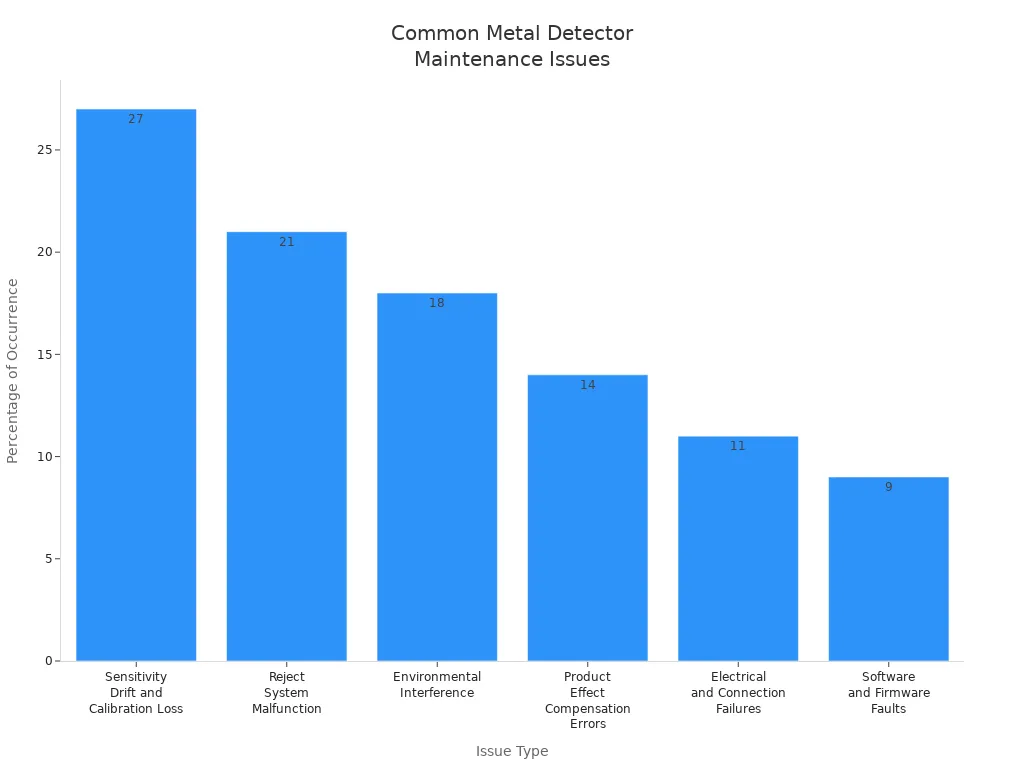
Maintenance issues can cause costly downtime. Sensitivity drift, reject system malfunctions, and environmental interference are common problems. Track sensitivity readings, schedule quarterly calibration, and verify reject functions daily.
| Issue Type | Percentage | Causes | Warning Signs | Prevention Strategies | Typical Cost Impact |
|---|---|---|---|---|---|
| Sensitivity Drift and Calibration Loss | 27% | Component aging, temperature cycling, electromagnetic changes | Difficulty passing test wand verification, increased sensitivity readings | Track sensitivity readings, establish drift thresholds, schedule quarterly calibration | $45,000-180,000 |
| Reject System Malfunction | 21% | Pneumatic failures, timing errors, mechanical wear | Slow reject action, inconsistent timing, unusual sounds during reject activation | Verify reject function at every test, monitor pneumatic pressure, include in daily maintenance | $75,000-250,000 |
| Environmental Interference | 18% | External electromagnetic fields, vibration, temperature extremes | Intermittent false rejects, performance varying with equipment operation | Survey electromagnetic environment, maintain clearances, install shielding | $30,000-120,000 |
Metal Detection Programs
You must create a formal metal detection program to meet food safety standards. Treat metal detection as a critical control point in your HACCP plan. Validate your system and document effectiveness. Schedule regular checks at startup, during production, and at shift end. Take immediate action if a detector fails to reject a test piece.
| Procedure | Description |
|---|---|
| Critical Control Point | Metal detection is often established as a CCP in HACCP plans based on risk assessments. |
| Validation and Documentation | Companies must validate their metal detection systems and document their effectiveness. |
| Monitoring Schedule | Regular checks are required, typically at startup, during production, and at the end of shifts. |
| Corrective Actions | Immediate actions must be taken if a detector fails to reject a test piece, including quarantining affected products. |
A strong metal detection program helps you manage risks, maintain compliance, and prepare for audits. Keep detailed records of tests, results, and corrective actions to show you meet FSMA and international standards.
You play a key role in keeping food safe by using metal detectors. These systems help you prevent hazards and reduce the risk of foodborne illness caused by metal contamination. Regular maintenance and monitoring ensure every product is checked. If you fail to implement robust detection, you face costly downtime and damage to your brand.
| Cost Implication | Description |
|---|---|
| Unplanned Downtime | Production halts increase operational costs. |
| Product Loss | Wasted products impact profitability. |
| Regulatory Non-compliance | Fines and legal issues affect financial stability. |
| Damage to Brand Reputation | Safety incidents harm consumer trust and sales. |
Combining metal detection and check-weighing equipment lets you resolve waste and quality issues, helping you maintain high detection sensitivity. You should prioritize strong metal detection systems to protect your customers and your business.
FAQ
What types of metal can food metal detectors find?
You can detect ferrous metals, non-ferrous metals, and stainless steel. Ferrous metals are easiest to spot. Stainless steel is hardest to find. Advanced detectors help you catch even tiny fragments.
How often should you test and calibrate your metal detector?
You should test and calibrate your metal detector at the start and end of each shift. You also need to check after repairs and during product changeovers. Regular testing keeps your food safe.
Where should you install metal detectors in your facility?
You should install metal detectors at points where contamination risk is highest. Common places include after processing, before packaging, and at the end of the production line.
What happens if your metal detector finds contamination?If your metal detector finds metal, you must remove the contaminated product. You should record the event and take corrective action. This step protects your customers and keeps your brand safe.
Do metal detectors work with all types of food packaging?
Metal detectors work best with non-metallic packaging. If you use metal packaging, you need special detectors or extra steps. You should always check your detector’s compatibility with your packaging.